

Korean Pine Nuts
| Product | Price | |
|---|---|---|
| 25 seeds, KOPN-25 | $52.00 |
|
Seeds-Plant Discoveries-New Crops-Ecological Enrichment Click Here!

| Product | Price | |
|---|---|---|
| 25 seeds, KOPN-25 | $52.00 |
|
.jpg)

Michigan Grown Seed Source from Northern Michigan
Selected from the original 'Grant Mudge' trees north of Traverse City, Michigan this seed strain highlights a life long interest in trees of Grant Mudge and his seedling hedge row of pine nut pines as well as one grafted tree he had put on white pine rootstock. Yes it is possible to graft a pine nut pine on the native white pine. The graft union was smooth and uninterrupted speeding the growth of the Korean pine. This is one of the few if not the only planting I was aware of in North America of any size. I was very fortunate to visit this planting with Grant was alive.
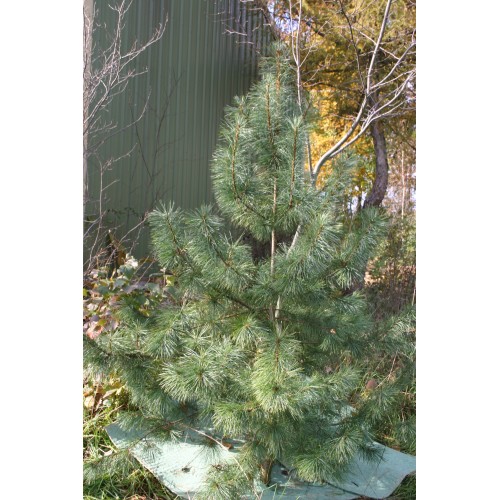
The pine nuts overlook Lake Michigan sitting on a sandy bluff. I was so grateful for the time he spent with me. This location was windy. cold and full of snow in the winter. The soil had minimal organic material with a few whispy grasses filling in the best they could. Subsequent harvests of pine nuts from this location was done with permission prior to the land being sold. I was told recently that the trees no longer exist. But who knows maybe a few linger on the edges. Over 30 years ago, I planted these seedlings through my farm and several started fruiting around the 25 year mark. Today some of the trees are more columnar and others are bushy. A total of three trees are fruiting with one tree having fairly large cones.
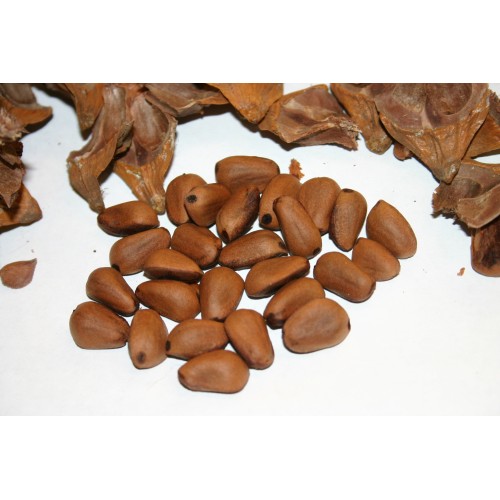
Korean pine needs additional seedlings for pollination which helps improve heavy cone production. It takes two years to develop the cone on the tree. The cones can be dried indoors and then agitated to drop the seeds. Squirrels are not much interested in the cones possibily because of the sticky sap covering the outside scales and the recessed seeds which do not fall out on their own the first year the cone is down from the tree.
Korean pine trees in the market are often grafted varieties. These are non-productive ornamental selections which rarely produce cones. The seeds available in the market are often over dried to the point they will not germinate. I've tried over and over from various seed houses. I take careful steps to extract and then after ripen the seeds in my barn prior to refrigeration. I also do a float test to remove the blanks.
TO GERMINATE THE SEEDS: The seeds are doubly dormant and require two years to sprout. Plant in a protected, screened flat covering the seed with 1/4 inch sandy seed mix. The flats if left outdoors and covered will then go through the natural dormancy of cold, warm and then cold again to sprout the second spring. You can limit your outside dormancy by doing the first dormancy in the refrigerator by using lightly moist media and storing them at 34F-40F for 140 days. Then plant in a protected flat for the remaining dormancy. The seedlings rarely damp off but if this is a problem use a light mix that drains well and do not over plant. The seedlings need air and light to grow the best. Transplant out to a nursery bed for two years before moving to a permanent location. A protected flat is one with the normal sized (medium) hardware clothe. The screen should be secured by caulking or stapling. The flats need to have holes no bigger than pencil size.
September-October 2026 seed crop refrigerated.
| Plant Specs | |
| Genus & Species | Pinus koreansis |
| Seed Source | Michigan. Ecos strain |
| Hardiness | Hardy to at least minus 30 F. |
| Height (ft) | Upwards to 80 feet tall. |
| Pollination Requirements | You will need at least two trees to get the wind born pollen upwards and around the female cones whcih often exist in the upper portion of the canopy. |
| Soil | Prefers sandy, dry soils with good drainage. No standing water or high water tables. |
| Climate | Prefers cold climates from Zones 6 to Zone 3. Tolerant to heavier moisture in air and soil than any other pine nut pines which are often found in arid, alpine and desert like climates. Those species all failed at my farm. |
| Ease of Cultivation | The eastiest pine nut to cultivate and grow to fruiting. There is a long maturation period for the tree. This can be sped up by grafting onto white pine trees which is said to be very easy to do. Seedlings grow upwards a foot a year. Trees are long lived reaching 100 years old easily. Hybrids are rare so it is needed a diverse seedling planting to get the most from the trees in terms of yields. Makes a nice ornamental tree and has potential as a durable white pine in places difficult to establish evergreen trees. It is said that certain pine mychorrizal benefit the tree and speed its growth. So it might be worth innoculating the seedlings to help in this process. |